Notifications (Click to mark read)
Ajna — To Perceive, To Command
The Sanskrit word Ajna carries two meanings that at first seem unrelated: "to perceive" and "to command." Together they describe exactly what the sixth chakra does. It is the centre of perception — the faculty that sees beyond the surface of things, that recognises patterns before the rational mind has assembled them into an argument, that knows without being able to immediately explain how it knows. And it is a command centre in the literal sense: in the yogic tradition, Ajna is understood as the seat of the guru within — the inner authority whose guidance, once accessed, can be trusted over the noise of social pressure, conditioning, and fear.
Located at the point between and slightly above the eyebrows — the position that most iconography marks with a dot or eye — the third eye chakra is the sixth in the seven-chakra system, sitting between the throat chakra below and the crown above. It governs not ordinary vision but the quality of seeing that involves interpretation, insight, and the recognition of what is true beneath what is apparent.
The Element of Light and the Two Petals
Every chakra from root to throat is associated with one of the classical physical elements — Earth, Water, Fire, Air, and Ether. Ajna breaks from this pattern. Its element is Light — not in the metaphorical sense of enlightenment, but as a specific energetic principle: the quality that makes things visible, that reveals form and relationship, that allows the eye to perceive what is there rather than what it expects to find.
Light is also the element that travels in straight lines, that does not bend around obstacles in the way that sound or water can. The third eye sees clearly or it does not see at all — there is no navigating around the truth at this level. What Ajna perceives, it perceives directly.
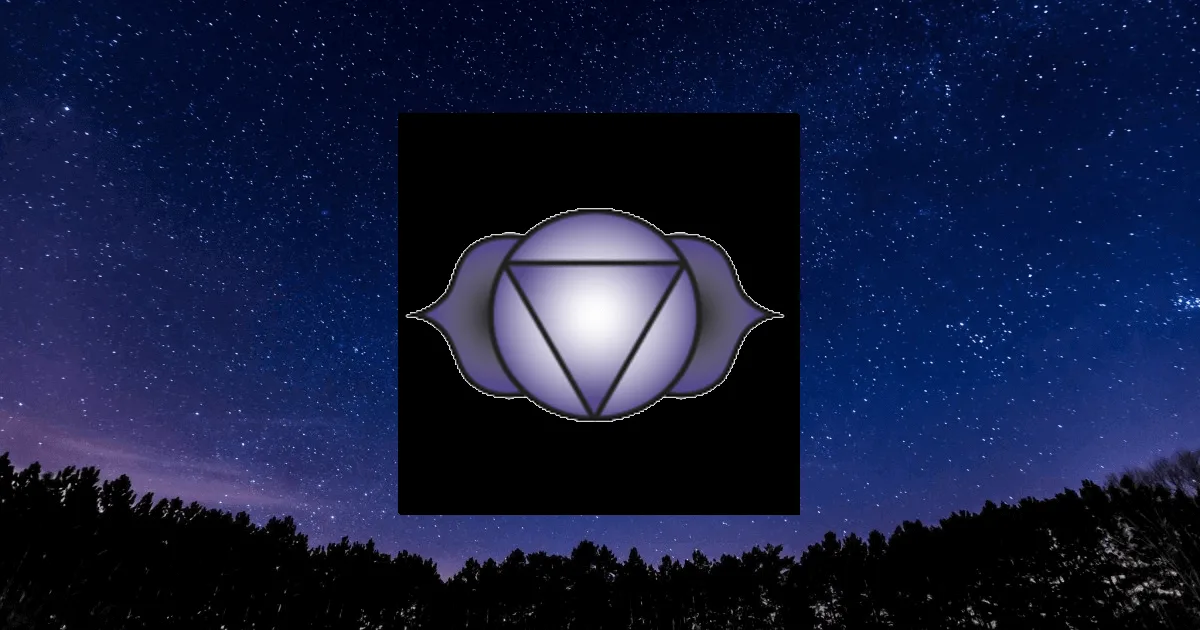
The lotus symbol for Ajna has only two petals — the fewest of any chakra. This is deliberately significant. Every other chakra from root (four petals) to crown (thousand petals) represents a greater multiplicity of qualities and energies. The third eye's two petals represent the union of opposites: left and right, logical and intuitive, masculine and feminine, the two hemispheres of the brain coming into a single point of perception. This is the chakra where duality begins to resolve — not by eliminating one side or the other, but by seeing from a vantage point that holds both simultaneously.
What Ajna Actually Governs
The third eye chakra governs the quality of perception across all levels — physical, emotional, mental, and intuitive. At the most basic level it is associated with the eyes and the visual cortex, with the sinuses and the brain's frontal lobes. The pineal gland is its primary physical correlate — a small, light-sensitive gland in the centre of the brain that regulates melatonin and the body's relationship with light and darkness, and which has been associated with mystical experience in traditions ranging from Descartes to Hinduism to Ayahuasca ceremonialism.
Beyond the physical, Ajna governs imagination in its most precise sense — not fantasy or wishful thinking, but the faculty that generates images and scenarios internally, that allows you to model situations before they have occurred, to visualise outcomes and recognise patterns across time. This faculty is the basis of both creative work and strategic thinking, and its quality determines much about how effectively you can navigate a complex life.
Intuition is Ajna's most discussed quality, and it is worth being precise about what intuition actually is. It is not a mysterious sixth sense that operates independently of experience and logic. It is the rapid, unconscious synthesis of pattern recognition built up over a lifetime of observation — the mind's ability to arrive at conclusions before the conscious reasoning process has completed its work. A healthy third eye chakra means trusting that synthesis rather than dismissing it because it cannot be immediately justified in rational terms. It does not mean abandoning critical thinking; it means adding the intuitive channel alongside it rather than suppressing it.
The command aspect of Ajna's name refers to this: when the third eye is functioning clearly, you have access to a quality of inner knowing that can guide decision-making with less dependence on external validation. The guru within is not infallible, but it is far less susceptible to the distortions of ego, social pressure, and conditioned fear than the everyday thinking mind.
Signs of Imbalance
A blocked or underactive third eye chakra tends to manifest as difficulty trusting your own perceptions, a chronic reliance on others' judgments over your own inner knowing, poor imagination, and a narrowness of perspective — the inability to see situations from multiple angles or to perceive what is not immediately obvious. There may be a quality of mental rigidity, an attachment to the literal and the already-known that makes new insight feel threatening rather than interesting. Headaches centred around the forehead and persistent sinus problems are sometimes associated with a suppressed Ajna.
An overactive third eye presents very differently: excessive fantasy, difficulty distinguishing intuition from wishful thinking or projection, being lost in imagination at the expense of practical engagement with reality, and in more extreme cases a tendency toward paranoia or the attribution of significance to patterns that are actually coincidental. The third eye, like any perceptual faculty, can be trained to see things that are not there as well as to see things that are. The distinguishing quality of genuine intuition is that it tends to feel quiet and clear; the distortions of an overactive third eye tend to feel exciting, urgent, or persecutory.
Physical indicators associated with Ajna imbalance include chronic headaches and migraines, visual disturbances, sinus problems, and difficulty sleeping — the body reflecting in its own terms the chakra's relationship with the pineal gland and the regulation of the sleep-wake cycle.
Working with the Third Eye Chakra
The most direct practices for Ajna involve training the quality of attention itself. Meditation is the primary tool — not because meditation is mystical, but because the consistent practice of returning attention to a chosen object (breath, a word, a visualisation) develops the precise faculty that the third eye governs: the ability to observe the contents of the mind without being wholly identified with them, to see what is actually there rather than what you expect or fear to find.
Visualisation practices work specifically with Ajna's domain — the deliberate generation of internal imagery, held steadily and with intention. These do not need to be elaborate. Spending five minutes each day deliberately picturing a simple object in as much sensory detail as possible exercises the third eye's capacity for clear inner vision.
Dream journalling is another underrated practice for Ajna development. Dreams are one of the primary languages of the unconscious pattern-recognition faculty that intuition draws on. Paying consistent attention to them — not necessarily through symbolic interpretation, but simply by recording them and noticing recurring images and feelings — gradually develops the quality of internal attentiveness that the third eye requires.
Reducing the noise that the rational mind generates is as important as adding new practices. The third eye's signal is often present but drowned out. Periods of deliberate silence, time in nature without technology, and practices that slow the pace of incoming stimulation all create conditions in which the quieter perceptions can be heard.
Crystals for the Third Eye Chakra
Amethyst is the most widely associated stone with Ajna, and its reputation is solidly grounded. Its purple-indigo colour resonates directly with the chakra's frequency, and its energy is clarifying and calming simultaneously — it quiets mental noise while sharpening inner perception. It is particularly supportive during meditation and before sleep, enhancing dream clarity and supporting the kind of receptive stillness in which intuitive insight tends to arise.
Purple Fluorite brings a quality of precision to third eye work that Amethyst does not always provide on its own. Where Amethyst opens and softens, Purple Fluorite organises — it helps bring mental clarity to intuitive impressions, assisting in the translation of vague perceptions into usable insight. For anyone who receives intuitive information but struggles to interpret or act on it, Purple Fluorite is a valuable complement.
Moldavite is in a different category entirely from the other two. A natural glass formed by a meteorite impact in the Czech Republic approximately 15 million years ago, Moldavite carries an intensity that many people find overwhelming at first contact. Its energy is accelerating — it tends to amplify whatever is already in motion, bringing suppressed perceptions to the surface faster than most people are comfortable with. It is not a stone for beginners or for casual use. But for someone whose third eye work has reached a plateau and who has a stable enough foundation in the lower chakras to handle rapid opening, Moldavite is genuinely unlike anything else.
Use Amethyst and Purple Fluorite regularly and as an integrated practice. Approach Moldavite with respect, in short sessions, and always with adequate grounding beforehand — Black Tourmaline or Hematite at the root while Moldavite is at the third eye is a combination that many practitioners find stabilising.